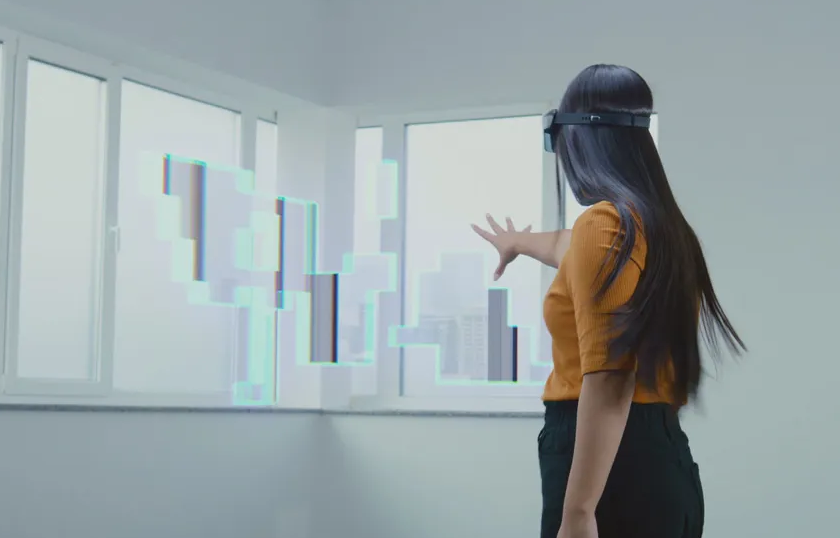
Stop sharing your screen and start sharing your space. Discover the secrets to mastering virtual presence and immersive public speaking in the spatial era of 2026.
Beyond the Flat Screen
For decades, public speaking was defined by the physical stage. Then, the 2020s forced us into the “Brady Bunch” grid of Zoom and Teams—a 2D experience that, while functional, lacked the essence of human connection: presence. But as we navigate through 2026, the paradigm has shifted once again. We have officially entered the Spatial Era. With the mass adoption of Extended Reality (XR) and Spatial Computing, the boundary between the speaker and the audience has dissolved.
Presenting in 2026 is no longer about talking at people through a glass window; it is about inviting them into your ideas. Whether you are pitching to a VC in a virtual boardroom or delivering a keynote to a global audience in a shared digital stadium, mastering Virtual Presence is now the ultimate professional differentiator. At Avanza Pro, we believe that the great orators of this era are not just speakers, but “Architects of Experience.”
1. The Anatomy of Spatial Presence

In a traditional video call, you are a head in a box. In the spatial world of 2026, you are a Persona—a high-fidelity digital twin that mirrors your micro-expressions, hand gestures, and spatial location.
-
The Eye Contact Revolution: Unlike 2D calls where looking at the camera feels disconnected from looking at the participants, 2026 XR headsets use advanced eye-tracking to ensure that when you look at someone’s avatar, they feel the eye contact. This is the “Social Glue” of virtual leadership.
-
Non-Verbal Fidelity: Modern sensors capture the subtle movements of your shoulders and hands. A Global Professional knows that in XR, your body language is just as loud as it is in person. Fidgeting with your virtual interface is the 2026 equivalent of looking at your watch during a speech.
2. From Slides to Simulations: Immersive Storytelling
The “PowerPoint” is dead. In 2026, if you are still using flat slides in a 3D environment, you are failing to leverage the medium.
-
3D Data Visualization: Instead of showing a bar chart of your company’s growth, you can now manifest a 3D model of that growth that the audience can walk through. You aren’t describing the data; you are allowing them to experience the scale.
-
Environmental Storytelling: If you are presenting a new architectural project or a logistics plan, you don’t show a photo. You teleport the entire audience to the digital twin of that location. This “Contextual Immersion” increases information retention by over 70% compared to traditional methods.
[Table: The Evolution of Professional Presentation]
| Feature | 2D Era (2020-2023) | Spatial Era (2026) |
| Medium | Flat Screen / Video Grid. | Volumetric / Persistent Space. |
| Visual Aid | Static Slides / Screen Share. | 3D Assets / Immersive Environments. |
| Eye Contact | Artificial (Camera-focused). | Natural (Biometric eye-tracking). |
| Engagement | Passive (Chat / Emoji). | Active (Interaction with 3D objects). |
| Audience Feeling | “I am watching a video.” | “I am in the room with the speaker.” |
3. The 2026 Technical Stack for Orators
To Avanza (move forward), you must master the “Stagecraft” of the spatial era. This requires a new set of tools:
-
High-Fidelity Personas: Spend time fine-tuning your digital avatar. In 2026, your “Professional Persona” is as important as your physical suit. It must look authentic, professional, and capable of conveying your specific brand energy.
-
Spatial Audio Mapping: Understand how sound works in a 3D space. As you move around the virtual stage, your voice should change in volume and direction for the audience. This creates a sense of “Physicality” that keeps the audience anchored to your presence.
-
Interaction Triggering: Learn to use gesture-based controls to trigger animations or change scenes. The most polished speakers in 2026 don’t use “clickers”; they use natural movements to manipulate their digital environment.
4. Overcoming “Spatial Anxiety” and Technical Friction

Public speaking is already the #1 fear for many. Adding a headset and a 3D environment can amplify that stress.
-
The “Stage-Fright” Paradox: Interestingly, some professionals find XR less intimidating because they are in a controlled environment. However, the fear of “Technical Glitch” is real.
-
The Pro-Active Buffer: Always enter the virtual room 10 minutes early to calibrate your sensors. In 2026, “Latency” is the new “Static on the line.” Ensure your neural-link or high-speed connection is stable.
-
Sensory Grounding: During long virtual keynotes, it is easy to lose track of your physical body. Professional speakers use “Tactile Anchors”—like a physical podium or a specific hand-rest—in their physical room that aligns with the virtual stage to stay grounded.
5. The Ethics of Virtual Presence
As we move into 2026, we must also address the “Uncanny Valley” and the ethics of digital representation.
-
Authenticity vs. Perfection: It is tempting to make your avatar 20 years younger or significantly different. However, trust is built on consistency. If you look like a Greek god in the XR boardroom but meet the client in person looking like a tired human, the “Trust Gap” can kill the deal.
-
Accessibility: A Global Professional ensures their spatial presentations are accessible to those who might only have 2D access or those with sensory processing differences. Inclusion in the spatial era means “Spatial captions” and descriptive audio triggers.
The New Orator is a Director
The transition to public speaking in the spatial era is not just a change in hardware; it is a change in mindset. You are no longer just a “speaker.” You are a director of attention, a designer of space, and a facilitator of immersion.
At Avanza Pro, we see this shift as the greatest opportunity for professional influence in history. In a 3D world, your ideas have volume. Your presence has weight. Your ability to move a person to action is amplified by the power of the environment you create. Don’t just show up to the meeting—build the meeting. Master the spatial stage, and you won’t just be heard; you will be remembered. The future of public speaking isn’t flat—it’s infinite.